

and be happier at work
Hello friends,
Today, I have an exciting news to share with you: Starting this week, I have just come back to teach at a university after almost three years working outside of the academic world. I believe that this role will help me achieve my mission at Dong Labs as well as my life purpose as a whole. On this occasion, I want to invite you into an essay where I contemplate on how to think (strategically) about the work that we do and the life we want to live.
Enjoy!

Work is a crucial area of life because the time you spend at work comprises at least 30% of your entire lifetime on Earth, amounting up to 80,000 hours, supposing that you work 40 hours a week, for 50 weeks a year, from the age of 22 to that of 62. However, many people do not think strategically enough about their work life.
There are two common traps when it comes to thinking about one’s work.
The content below was originally paywalled.
One is the belief that work is something we have to do, even if it is no fun.
Work is not something to be enjoyed, but rather something to be endured. Such suffering is necessary, for it will give us the authority, status, love, admiration, money, or other material perks that ultimately make our lives become perfect some day when we are rich or well-respected enough.
This way of thinking is dangerous because it can trap us into decisions that are against our own best interest. If we choose a job because of its external incentives such as a socially-desirable title or a lucrative paycheck, but it costs us time and energy for other life areas that are equally important to us, we might not even realize that there is a problem.
I have seen people who fell into this trap so deeply that they keep climbing the corporate ladder for higher material perks, even if they become less and less connected with their work. This can ultimately lead to burnout, a phenomenon when you care too much for way too long about something or someone you no longer feel bonded with. This is a form of procrastination on doing the hard work of thinking strategically about your work life.
The second common approach to thinking about one’s career is overrating passion.
Here, people believe that work should always be stimulating and fulfilling, providing a sense of flow and joy at every single moment. However, there is no such work. Every job, no matter how exciting or self-concordant, has its own undesirable parts and the inevitable ups and downs that you have to run through.
This way of thinking is harmful because it might trap you into forever looking for a perfect job while staying stuck at your current one, feeling unhappy all the way. This attitude also affects your performance because you do not seek to develop your skillset needed for your work. Without growing your skills, your ability to change the status quo becomes even harder.
What most people often miss is that they can always pick a specific activity of their work routine that they enjoy, and improve the skills related to that part to the level that allows them to engage more in that section and less in other non-desirable parts. As they become more adept at their skills, their negotiation power increases. Now, they can design the work that matches the life style they want and the life values they want to uphold.
To avoid these common but unproductive approaches to job thinking, I propose that you think about your work the way you plan your company project.
One very useful framework is the six-level model for reviewing your work introduced by David Allen in his 2001 book Getting Things Done. I adapted this into a life design pyramid and shared this in our community workshop in May 2024 (image below).
Definitions of each level:
Purpose: What change in the world do you want to achieve with your work?
Vision: Given that you purpose is achieved, how does the world around you look like in five to ten years?
Objectives: What do you want to achieve in one or two years?
Areas: What or whom are you responsible for or committed to for a long time?
Projects: What will you create this week to achieve your goals?
Actions: What is the one next action you can get done that moves you closer to your goals?
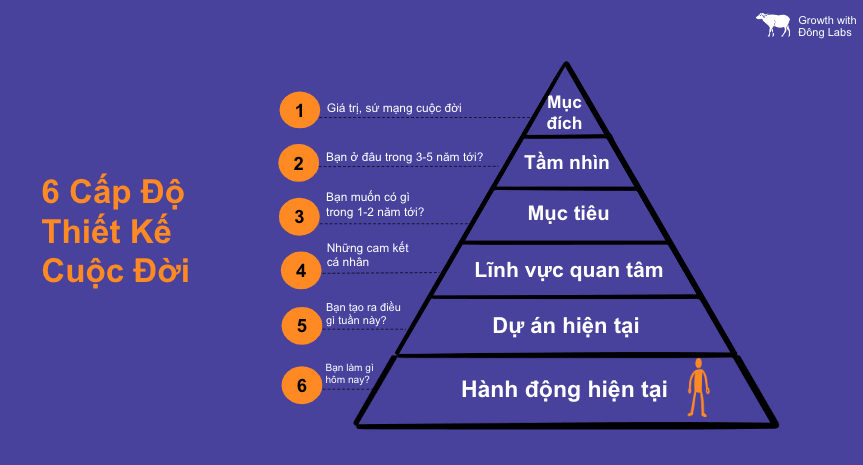
It is very important that we can shift through all six levels frequently enough in order to connect the messiness of day-to-day decisions at work with the higher-order levels such as your life mission.
For example, if you struggle to maintain a habit, you might ask yourself why do you want to adopt this habit so much or how does this habit supports your active projects or future goals.
When you are stuck, you might ask yourself what is the single next action that will drive you one step close to your desired outcome. On the contrary, when you experience an episode of burnout, you might pause and ask, what is this for, after all, or what is the ultimate impact I can make in the world by being so hard-working.
If you can write the answers to these questions and review them regularly, chances are that you will find yourself having more creativity and clarity about your work than ever before. Having six different lens to see your work is the superpower every person can practice to be happier at work.
How do you think about your job? Share with me in the comment.